

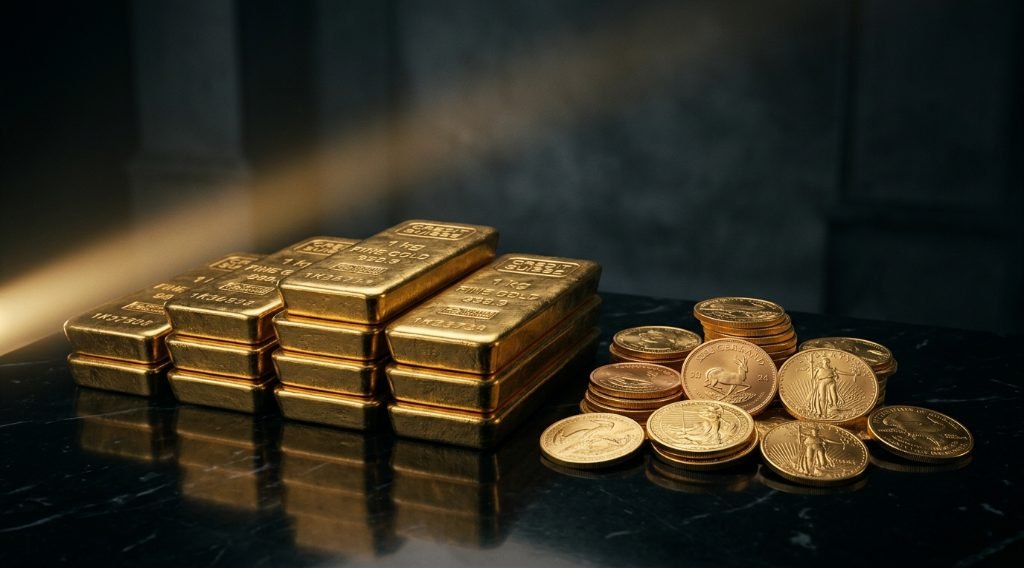

Gold’s sharp pullback since record-setting highs earlier in the year has rattled investors, but some of the most recognizable names on Wall Street are sounding off about a potential turnaround.
Over the past few months, there’s been a tug of war between the bulls and the bears over gold’s next move. While recognizing short-term headwinds, major institutions have consistently underscored the metal’s strong long-term fundamentals.
At the year’s midway mark, a consensus is starting to emerge from banks, research institutions, and even reserve officials that gold is moving closer to a floor. This convergence reinforces the idea that gold’s current downturn is a correction rather than a bear market.
HSBC Says Downside Risk May Be Limited
HSBC is one of many financial institutions that reduced its gold price predictions for 2026 in response to near-term obstacles, but the bank’s trimming doesn’t paint a complete picture of its projection. After cutting its forecast, HSBC argued that the downside risk for gold is limited.
In short, analysts believe much of the burden stemming from a stronger dollar and higher interest rates has already weighed on the gold market. In other words, the bad news that pushed gold lower may already be reflected in the price. The bank is pointing towards stabilization rather than structural weakness.
Saxo Sees Liquidation Turning Into Base-Building
Saxo Bank builds on HSBC’s breakdown, specifically pointing to gold’s price action. In the Danish bank’s view, the metal’s chart performance indicates a period of consolidation and base-building, instead of signaling an extended correction. This technical analysis points toward a market establishing its footing before moving higher.
After gold climbed to a new peak in January 2026, speculative traders took the opportunity to lock in gains, putting temporary selling pressure on prices. This is a routine occurrence when an asset rallies for an extended period. Gold’s doubling in a matter of years fits that description. The silver lining, as Saxo Bank explains, is that the market has shaken out short-term traders, clearing out the excess for more long-term buyers to reestablish control.
UBS Calls It a Buying Opportunity
In a recent report, UBS directly referred to the current dip as a buying opportunity for investors who want more gold exposure. Furthermore, the Swiss bank predicts that gold will stage a recovery of 28% over the next 12 months.
Analysts leave open the possibility for more sideways trading before this upswing, but they believe the challenges posed by the Fed’s policy and the U.S. dollar are slightly overblown. At the same time, the bank reaffirmed its confidence in the long-term case for gold, reinforcing its forecast for a near-term recovery.
OMFIF & WGC Show Central Banks Reinforce the Floor
A recent study by the Official Monetary and Financial Institutions Forum (OMFIF) shows that physical gold remains a pillar of central bank reserve strategies. 82% of central banks hold tangible gold products, up more than 10% from last year. The report demonstrates how official demand is based on strategy instead of the timing of prices.
Similarly, the World Gold Council’s (WGC) survey of reserve officials revealed central bank gold buying expectations reaching a record high, with 45% of respondents planning to increase their reserves over the next year. Both the OMFIF and WGC findings show persistent central bank demand as a cornerstone of support for gold prices.
Banks Aren’t Ignoring the Headwinds
Lately, many investors have been wondering why gold is declining amid inflation and war, even though it’s considered an inflation hedge. Even as expectations of a gold bottom grow, banks aren’t ignoring the metal’s temporary challenges. A whirlwind of macroeconomic, fiscal policy, and geopolitical factors has placed near-term pressure on gold prices, including:
- Hawkish Fed policy has forced investors to rethink earlier expectations for rate cuts.
- Higher Treasury yields have made interest-bearing assets more attractive compared to non-yielding gold.
- A stronger U.S. dollar has pressured gold by making it more expensive for foreign buyers and pulling capital toward U.S. assets.
- ETF outflows and futures selling have added pressure on the paper side of the market.
- Profit-taking after gold’s record run has accelerated the correction as short-term traders locked in gains.
Gold’s Pullback Is a Correction, Not a Collapse
Nobody can predict with absolute certainty whether gold prices will fall further in 2026, but some of the biggest names on Wall Street are coming to a bullish conclusion: gold prices are in the midst of a correction, not a full-blown collapse.
This positive thesis doesn’t necessarily mean gold prices will trend higher immediately or in a straight line. These financial institutions still recognize the climate of volatility caused by fiscal policy, economic conditions, and geopolitical factors. Still, the rising agreement among Wall Street is that these headwinds are losing momentum, allowing the stronger fundamentals to retake control of the market.
At its core, the most important question for long-term holders is whether the reasons to own gold have changed. With central banks keeping their foot on the gold-buying pedal, fiat currencies losing credibility, and national debt spiraling out of control, the main drivers of gold’s rally remain unchanged.
If anything, the current pullback may give investors a chance to add protection before the next leg higher begins.